In this guide
Students remember field trips for years. The best ones are the trips where they did something, not just looked at it.
Virtual reality is one of the most hands-on experiences you can give a class. Here's how a VR field trip works, how to connect it to learning, and how to plan one without stress.
Why VR works for school and youth groups
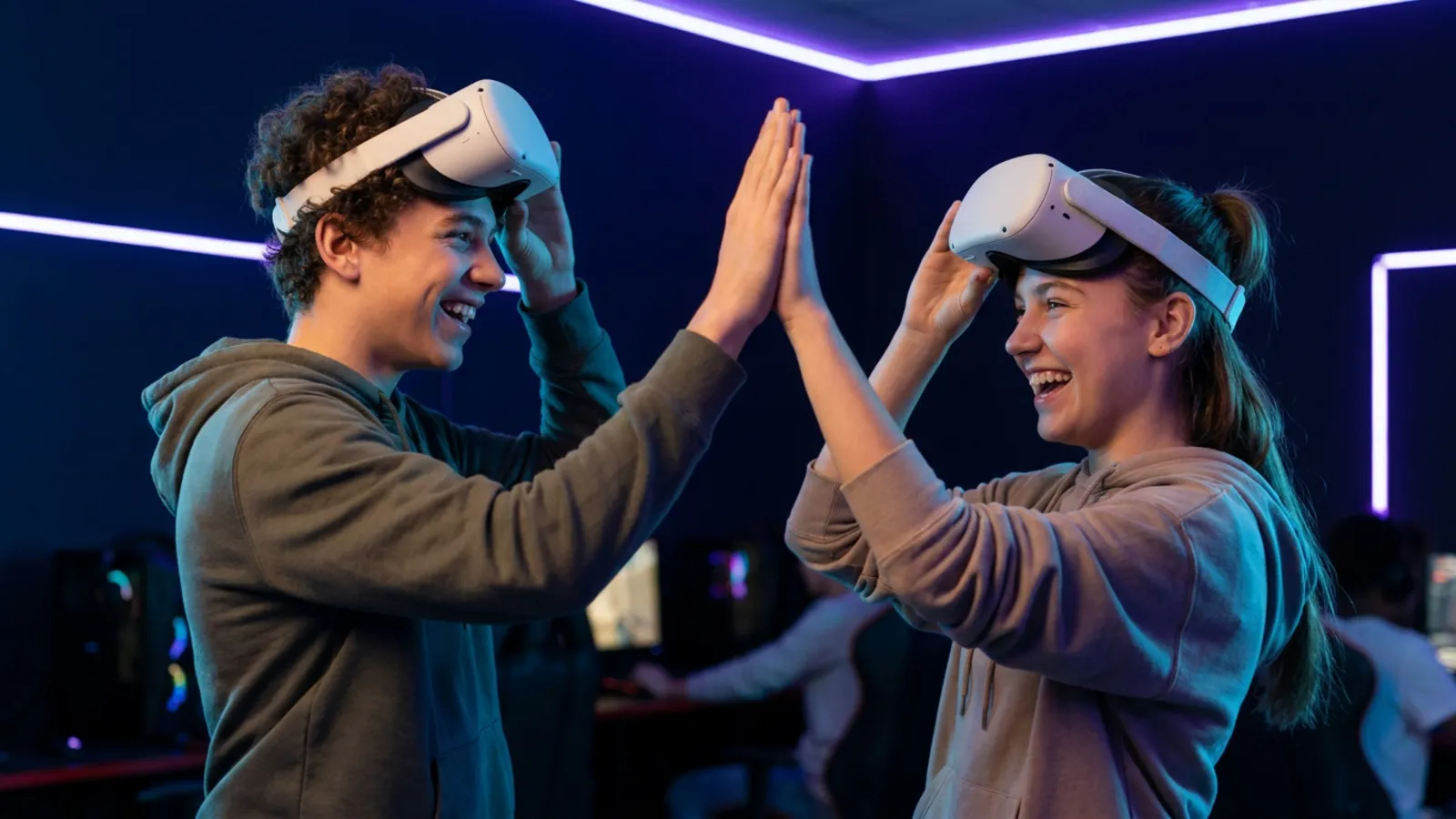
Everyone participates
In a free-roam VR arena, nobody sits on the sidelines. Students move, communicate and solve problems as a squad.
It levels the playing field
Most students have never tried free-roam VR. The quiet student and the class clown start at the same level, and teachers often see new leaders emerge.
It's a talking point for technology
Students don't just play with VR, they see it working: tracking systems, wireless headsets and motion simulators. That makes it a natural bridge to conversations about technology, design and careers.
Connecting the trip to learning

A VR outing isn't a lecture, and it shouldn't pretend to be. But a few simple prompts turn it into a richer experience. Adapt these to your grade level:
Before the trip
- How does a computer know where you are in a room?
- What jobs go into making a video game? (Designers, programmers, artists, sound engineers, testers)
After the trip
- Teamwork reflection: what did your squad do well? What would you change?
- Physics discussion: how does the VR Magic UFO or VR Flash Racer use motion to trick your senses?
- Design challenge: sketch a VR game you'd want to play. Who is it for? What's the goal?
- Writing prompt: describe the virtual world you visited to someone who has never tried VR.
What students experience at Elyonexus
- VR Arena: a free-roam squad mission for up to six players at once
- VR Mini Arena: a compact arena for one or two players
- VR Flash Racer: head-to-head racing simulators with real steering and pedals
- VR Magic UFO: a motion platform for up to five riders
- VR Mecha: a full mech cockpit, one pilot at a time
Rotating students through the experiences keeps everyone busy, and our staff brief each group before they play.
Safety and supervision
- All experiences are for ages 6 and up
- Trained staff monitor every session in real time
- The arena has padded walls and soft flooring, and emergency stops are always accessible
- Headsets and equipment are cleaned and disinfected between every session
- Students with epilepsy, photosensitivity, heart conditions or a history of motion sickness should check with a doctor first. See our Safety Rules
Field trip planning checklist
Six weeks out
- Get approval from your school or organisation
- Contact our events team with your group size, grade and preferred dates
- Arrange transportation
Three weeks out
- Send permission forms home with the digital waiver link. A parent or guardian signs for each student under 18
- Collect any medical or accessibility notes
One week out
- Confirm final numbers
- Remind students to wear comfortable clothes and closed-toe shoes, and to tie back long hair
On the day
- Arrive a few minutes early for check-in
- Split the class into squads ahead of time
- Leave 10 minutes at the end for a group debrief
Book a group visit
We're at Unit 11, 10940 119 Street NW, near NAIT, MacEwan and downtown Edmonton, with free parking out front.
Contact our events team for school and youth group options. We reply within 24 hours.
Frequently asked questions
What age groups can do a VR field trip at Elyonexus?
Our experiences are for ages 6 and up, so most elementary, junior high and high school groups can take part.
How large a school group can Elyonexus host?
Private bookings can take groups of up to 40. Larger classes can be split across time slots.
Do students need waivers?
Yes. Every participant needs a digital waiver, and a parent or guardian signs for anyone under 18. Waivers can be completed online in advance.